
Contact Angle Goniometry
Technique:
The angle at which a liquid interface meets a solid surface is called the contact angle. When a liquid has a low contact angle, the liquid is attracted to and will spread out onto the solid surface. Consequently, when a liquid has a high contact angle, the liquid is repelled from and will create a bead of liquid on the surface. Contact angle goniometry is used to measure this angle.
Instrument:
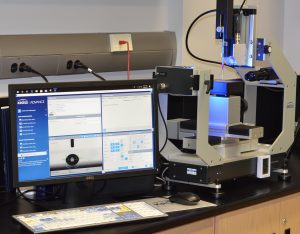
The DSA30E Drop Shape Analyzer is a powerful piece of equipment which is used for accurate measurements of surface free energy (SFE) and contact angle.
The DSA30E is equipped with a uniform LED lighting unit, high-resolution camera, and high-quality optical components. The outcome is a precise image of the dispensed drop which ensures that the drop shape can be reliably evaluated for the contact angle.
The software programming, semi-automatic measuring sequences produce accurate results with a speedy turn-around time.
The DSA30E not only measures the contact angle, but also measures the surface tension of liquids using the Pendant Drop method.
Tasks and Applications
- Characterization of surface pre-treatment processes
- Investigate the wettability of metal, wood, glass or plastics
- Study surface cleanliness
Measuring Methods
- Contact angle measurements between a liquid and a solid
- Surface-free energy from contact angles of several test liquids
- Static, advancing and receding contact angles
- Surface tension
- Assessment of surface tension using the Pendant Drop Method
- Analysis on inclined surfaces
Features
- Internal Tilting table
- Special sample holders for contact lenses
- Dosing accessory for Captive Bubble measurements
- Software controlled x- and y-axes and manual lift table (z-axis)
- Software-controlled single-dosing unit
- Zoom lens 6.5 times
- Camera with 1200 x 800 px at 200 fps to 90 x 60 at 2000 fps resolution
- Bright homogenous LED illumination
- Software for measuring contact angle and surface free energy of solids and surface tension of liquids
- Liquid needle attachment – very useful for superhydrophobic and superoleophobic surfaces